
Data Integrity by Design: How Automated Plating Secures Your qPCR Results

In our previous From Plates to Pools post, we discussed how moving from manual mapping to automated plate logic breaks the R&D bottleneck, but how does that logic scale when you introduce the multi-layered requirements of high-throughput qPCR?

qPCR is the gold standard for quantification, but it is also the ultimate stress test for any plating workflow. When designing plates manually, qPCR becomes a "mental marathon". Coordinating multi-variable master mixes while tracking technical replicates across hundreds of wells can make the process high stakes. The cognitive load is immense, and the margin for error is thin.
At Karchem Consulting, we have tailored our qPCR solution to handle the complexity that manual mapping cannot. While our solution is built to easily manage high-volume replicates and controls, it is flexible enough to be tailored to the specific needs of any workflow. This transition from manual mapping to automated logic begins by addressing the bottleneck of the initial plate design.
Why qPCR is More Than Just "A to B"
In a standard plating task, you move a sample from tube A to well B. In qPCR, that path is rarely linear. The transition to high-throughput volume introduces three specific friction points that make manual mapping a liability:
The Replicate Web: Samples are not just moved; they are multiplied. Whether running duplicates or triplicates, the mapping logic must ensure that each replicate is tracked. A single manual entry error does not just ruin one well. It can compromise the statistical power of the entire sample set.
The Master Mix Intersection: Plating qPCR is not a single-liquid task. It requires coordinating a grid where multiple master mixes are combined with various DNA or RNA templates. This friction compounds when labs introduce multiplex assays, such as combining target genes like FAM-label marker with a housekeeping reference gene like a VIC-labeled control in the exact same well. Managing this matrix manually is where most of the logistical strain typically hits a wall. One misplaced primer set can lead to an entire plate of ghost results or false negatives.
The Control Problem: No Template Controls (NTCs) are the safety net of any assay. In high-throughput environments, they can be easily misplaced or overlooked. A common frustration occurs when a complex 384-well design is finished, only to realize that the controls were left off the map. Because NTCs are foundational to data integrity, they cannot be tacked on at the end. They must be baked into the logic from the start.
Automating the Invisible Steps: Building the Guardrails
If manual mapping is a recipe for human error, automated logic is the guardrail that keeps the process on track. By letting relational logic handle the mapping, high-throughput qPCR becomes a routine task rather than a nightmare for a scientist.
The logic behind coordinating multiple master mixes with DNA/RNA templates is entirely replicable. By using relational logic, scientists can ensure that replicates are traced with absolute accuracy. Automation can seamlessly manage the master mix intersection and automatically coordinate the grid. Most importantly, it can bake in controls (NTCs) as a foundational part of the architecture logic, ensuring they are never an afterthought or a "forgotten" add-on at the end of a design. By establishing these guardrails during the plating phase, the downstream analysis shifts from a manual chore to an automated certainty.
Tailored to the Workflow
qPCR is used across a variety of research scenarios, each with its own requirements. Detailed below are three specific automation use cases we have built for clients. While these solutions were integrated via Benchling Connect, the underlying logic is built to be flexible. It can be tailored to any system or workflow, enabling a variety of specific plating strategies that adapt to the science rather than forcing the science to fit the tool.
Note: For clarity, some plate maps have been cropped and color-coded to highlight specific sample distributions.
Screening:
In screening workflows, the main challenge is volume. The logic manages the transition from 96-well plates to multiple 384-well output plates based on defined dilution concentrations or replicate selections. For example, the solution can automatically fill a 384-well plate with the appropriate entities from a 96-well plate, based on an indicated plating schema. In the image below, a dilution plate is created from the 96-well sample plate with four replicates of each sample per plate.

Dose Response:
In dose response workflows, the main challenge is mapping dilution series across dozens of samples. Mapping 8, 10, or 12-point series is a high-error task when done by hand. This logic registers plates by intersecting sample lists with specific concentration gradients. Whether the layout requires vertical or horizontal stamping, the automation can ensure that every well contains the right concentration and reagent mix defined in the run input.

In Vivo Multi-Tissue Biodistribution:
In vivo studies require logic that can handle highly variable experimental matrices. Unlike static screenings, specimen-based studies often require splitting diverse sample matrices (such as tracking a target gene across liver, spleen, and kidney tissues) across specific target primers while maintaining consistent control baselines across multiple plates. Automation can handle this complexity behind the scenes by parsing sample metadata or various input fields (e.g., replicates, sample numbers) to ensure that what ends up on your plate matches your experimental design.
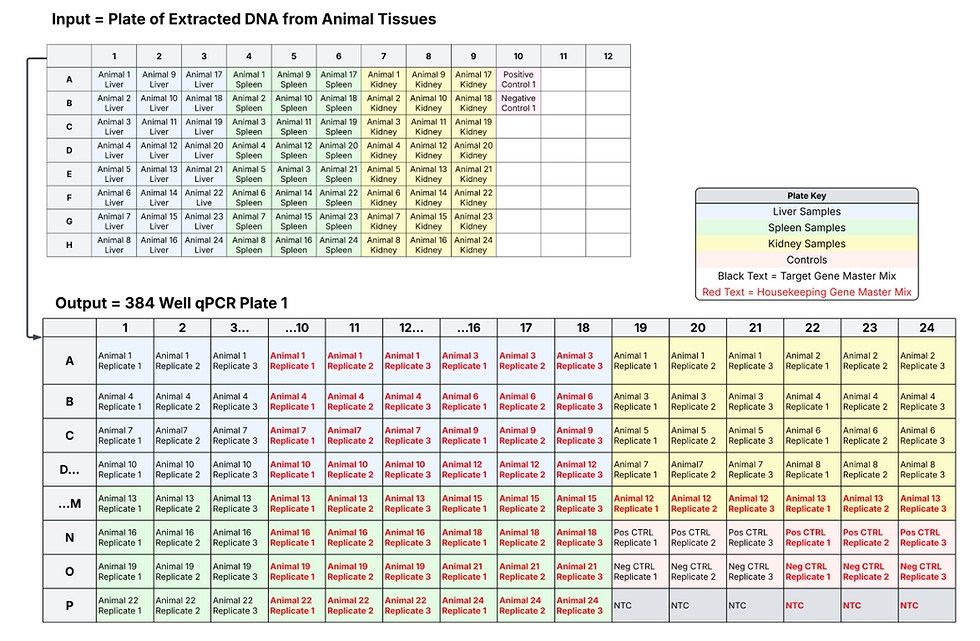
When it comes time for analysis, the system uses this automated plating to its advantage. Because plate registration is standardized, the logic can be used to map concentration gradients and samples to the raw instrument data, enabling scripts to calculate results and link them directly to the treatment dose.
Beyond Plate Mapping: From Layouts to Logic-Driven Analysis
While much of the focus has been on automating the physical side of the lab, the real power of automation is realized after the assay is complete. Once the plating strategy is established, the data is already structured for the next step: analysis.
In our previous post, we solved the speed problem by breaking the manual bottleneck that keeps plates from moving through the lab. But high-speed plating inherently creates a high-volume data problem. Manually managing raw machine files, complex dCt and ddCt calculations, and filtering for replicates across multiple plates can be a heavy burden. By automating the analysis alongside the plating, we simplify the process. Our automation framework can handle the data-heavy lifting by:
Parsing the raw instrument data and mapping it to the registered plate and entity IDs.
Calculating complex dCt and ddCt calculations, including control averaging or accurately pairing raw Ct data with standard curve dilution gradients for absolute copy number quantification.
Aggregating data by entity to find the average ddCt, %CV, and treatment doses without a single manual spreadsheet entry.
While qPCR serves as an ideal showcase for complex plating logistics, this framework expands seamlessly to other critical core assays. The same architectural guardrails can apply to workflows such as ELISAs, cell-based potencies, or multiplex bead arrays. Whether your assay requires mapping logistic regression curves for an antibody titer, calculating dilution factors, or linking raw optical density readings back to sample registries, relational logic can handle the heavy lifting.
At Karchem Consulting, we don't just help you plate faster. We can ensure your data is sound and well-traced. By removing the friction of manual data handling, we can close the workflow loop and ultimately reclaim valuable time for scientists. Scaling your science means scaling your data integrity.
Ready to move beyond the manual ‘mental marathon’ of qPCR? Connect with Karchem Consulting today to streamline your path from raw data to results.

