
Bio-IT World Conference & Expo 2026 Recap: The Bottleneck of Modern Biotech

Why Clean Data Still Trumps AI Algorithms
Team KC’s Talia Karchem, Xandria Kovacic, and Sophia Donnelly were in Boston for the 2026 Bio-IT World, connecting with old and new faces. And, much like our recent Lab of the Future recap, we found that the industry remains heavily focused on AI enablement, but the conversation is maturing.
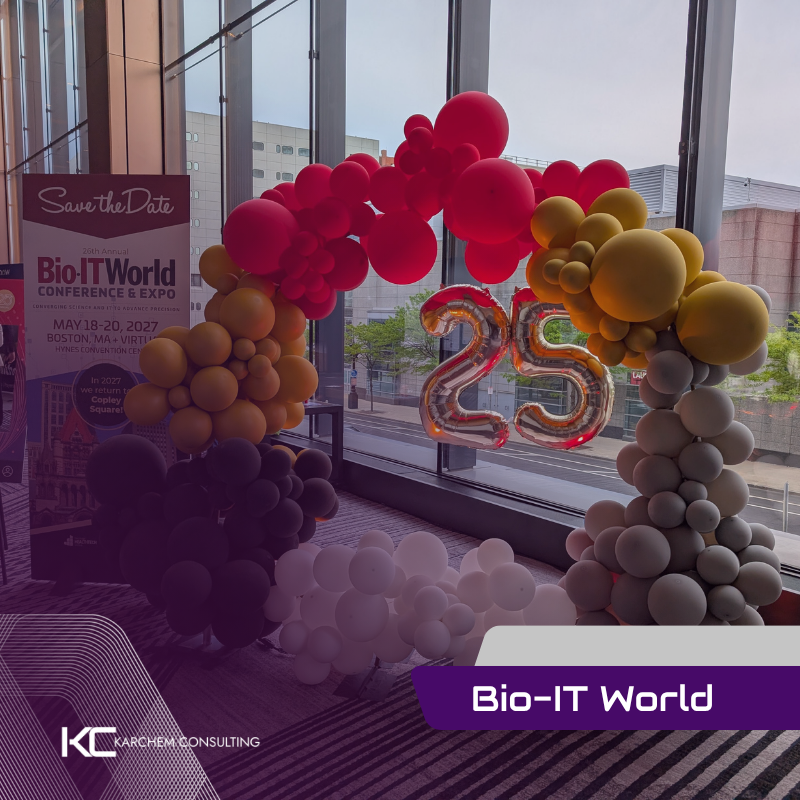
The excitement hasn't faded, but the questions are continuing to sharpen. Not just ‘how can we use AI' but ‘what has to be true before AI actually works?”
Across sessions, exhibit hall conversations, and our own co-hosted reception with Quilt and Tennex, one theme surfaced again and again: clean, structured, trustworthy data isn’t a prerequisite just to help you someday; it's the prerequisite, full stop.
Hear from Talia, Xandria, and Sophia to see what stood out, what surprised them, and what they're still thinking about now that they're back:
Q: What was your goal for attending BioIT 2026?
Sophia: Since my background is almost entirely rooted in science-focused conferences, my main goal was to bridge the gap between the wet lab and the lab informatics world. I was interested in seeing how massive amounts of data generated are actually being structured, cleaned, and scaled to drive therapeutic discovery.
Xandria: My goal for Bio-IT this year was really just to learn — and honestly, to reset a little. When you're deep in client work, it's easy to lose sight of the bigger picture, so it's great to have a conference like this that pulls you back to those higher-level principles. And on top of that, having so many of our clients and partners all in one place? That alone made the trip worth it.
Talia: Having attended BioIT for roughly 15 years, I always enjoy the presentations and exploring the exhibit hall to connect with vendors. However, the most valuable aspect for me is the chance to catch up with colleagues and friends I typically only see once a year at this event.
Q: Did you notice overarching themes throughout the conference?
Sophia: Many presentations focused on preparing data for AI, with frequent mentions of the FAIR data principles (Findable, Accessible, Interoperable, Reusable). Laying a structured foundation is the essential first step for any AI initiative.
Xandria: AI was absolutely everywhere. I mean everywhere. I actually made a point of attending a non-AI track, Pharmaceutical R&D Informatics, thinking I'd get a bit of a break from it, but even those presentations kept circling back to AI. At this point, it's just the reality of where the industry is. The other thing that kept coming up, though, was this idea that AI is only as good as the foundation underneath it: your data, your processes, your people, your systems. You can't just bolt AI onto a messy infrastructure and expect magic. You have to do the foundational work first.
Talia: As expected, AI was an extremely popular topic. While there were quite a few talks on how leveraging AI has helped various companies/programs accelerate, there were also discussions on how to apply guardrails to the technology. Key sessions at the event also focused on practical applications, including generative AI tools, AI for biologics, and drug discovery.
Q: What’s the most interesting insight you took away?
Sophia: Coming from the science side, the biggest eye-opener was just how much 'bad data' slows down drug discovery. I heard a statistic that data scientists still spend up to 75-80% of their time just cleaning and formatting messy biological data before they can run a single model. The real bottleneck in modern biotech isn't the AI algorithms themselves but building clean, reliable data pipelines that bridge laboratory instruments directly to the cloud.
Xandria: The talk that stuck with me most was "The Bilingual Scientist: Building the R&D Workforce of 2030" by Michel Rider, Global Head of Digital R&D at Sanofi. She spoke about how the industry is quietly but meaningfully shifting, from the roles and job descriptions to the skills you need to be effective. One thing she said that I loved was this idea of giving your team dedicated time and space to learn, whether that's a built-in block each week or what she called "learning vacations." With AI bringing so many new tools and techniques to the table, upskilling can't just be an afterthought. It has to be intentional. And that hit close to home, because it's something we've been actively trying to build into the culture at Karchem Consulting, too.
Talia: StarfleetBio (love the name) has built an app that runs analysis on your Whole Genome Sequence directly on your phone. The data - genetic data and all analysis, including kinship, origin, and health information - is encrypted and accessible only to you. It’s currently only available on iPhone, but I hope they’ll be extending it to Google soon.
Q: Did you have a favorite talk, booth, or conversation?
Sophia: One quote from the sessions really stuck with me: “When data is trusted, science moves faster.” This really captures why there was such a massive emphasis on the FAIR data principles this year. It’s not just about standardizing data so you can query and analyze it; it’s about creating a foundation of trust so you can confidently synthesize insights and make reliable predictions.
Xandria: Karchem Consulting hosted a Bio-IT reception with Quilt and Tennex during the conference, and I ended up in this really deep, technical conversation with a data scientist and an informatics lead about sequencing pipelines at their respective companies. We got into the weeds on how to properly track your sequencing data model within an ELN or LIMS, including the runs themselves, and even how you can automatically generate sample sheets from there. What struck me was the reminder that so many organizations are still managing all of the communication, handoffs, and analysis for sequencing runs in a pretty manual way. It's one of those things that sounds surprising until you're in the thick of it, and then it's all too familiar.
Talia: There was a particularly interesting panel titled “Leveraging Cloud to Break Data Silos and Power AI in Life Sciences” with representatives from the Broad Institute, Vertex, Takeda, Flare Therapeutics, and independent consulting. They discussed how they’re leveraging AI at their organizations, which are quite diverse. They brought up how to implement governance and processes without hindering their teams in using AI tools. Some organizations are jumping in without guardrails, but many are looking for ways to reduce the risk of cost ballooning and IP security risks.
Q: What was your “hot take” from the conference?
Xandria: A lot of organizations are really excited to talk about AI, and rightfully so, but many haven't quite dealt with what's already in the closet. I'm talking about decades-old software still in active use, disconnected systems that don't talk to each other, or processes that persist simply because “that's how it's always been done.” There's a natural tendency in this space to gravitate toward the exciting, forward-looking conversation, and that energy is valuable. But real, meaningful change requires a lot of unglamorous technical work.
Talia: I hear this at pretty much every conference I go to these days, including BioIT, but it still seems that most people in the industry are unaware, so it bears repeating: for AI to be truly useful, data needs to be at least somewhat organized. Like with any technology, “garbage in/garbage out” applies to AI tools as well. Achieving "AI-ready" data can be difficult as it requires moving beyond unstated assumptions and inconsistent collection practices. Without a solid, standardized foundation that serves both humans and agents, AI pilots are likely to fail or produce untrustworthy results. Organizations must focus on semantic harmonization and proper data structuring to ensure interoperability and long-term data reuse.
If there’s a single thread running through everything our team heard in Boston, it’s this: the bottleneck in modern biotech is the lack of time spent (or having been spent) on the foundation. Organizations racing to deploy AI without first addressing the legacy systems, disconnected workflows and platforms, and inconsistent data practices are likely to find themselves cleaning up the same mess but at a greater scale and cost.
Luckily, the path forward is well understood. FAIR data principles, semantic harmonization, structured and connected lab informatics systems; not new ideas, but the urgency to implement them has never been higher. That's exactly the work Karchem Consulting does every day.
If your team is navigating questions about data readiness, system selection, or how to build the infrastructure that makes AI initiatives actually viable, we’d love to talk. Contact us to start the conversation.


